Eight posts ago I reported my results from Ancestry.com. The biggest surprise was the 8% Finnish/Volga-Ural ethnicity.
In the earlier post, I mostly made jokes about the 8% "uncertain" part of the results. But on a more serious note: do people, when they see their results, identify more with whatever they find out they are? Do other people's allegiances undergo a subtle shift based on the results of their DNA test?
As I Google-Imaged "Finnish people" after seeing my results, did I feel a faint tug, a sense that these are my people? Not really. It was more just a feeling of mild curiosity. Will I now think of runner Paavo Nurmi, the "Flying Finn," or sniper Simo Hayha, the "White Death," with a small sense of pride? Probably not. But, after all, I'm only 8% Finnish. What if I had turned out to be 50% Finnish? My guess is that I probably would feel more of a sense of identification.
I have yet to meet the person of Irish descent, for instance, who does not make a fairly big deal out of the fact that he is Irish. What if someone who'd been adopted were to find out that he was 100% Irish? (Ancestry.com does not distinguish between the British isles, but for argument's sake, let's say they did.) Would that person then become a semi-professional Irishman like so many others? Would he, mid-life, all of a sudden be tempted to say self-deprecating things like, "It's hard to get anything into my thick Irish skull?" Or "Hey, I can't help it, I'm Irish, I like to drink?"
Or what if someone who had been adopted were to find out that he's 100% Jewish? Would his stance toward Israel become more charitable? Would he be tempted to learn about the religion, and possibly go through some of the rituals (short of a bris)?
After all, our ancestral DNA is who we are, at the most basic level. It's who we tend to identify with, who we root for, and who we side with. It's not coincidence that both Jesse Jackson (in '84 and '88) and Barack Obama (in '08 and '12) got upwards of 98% of the black vote in the primaries.
I recently asked a conservative young white man -- let's call him William -- what he would do if he found out he was part black. He immediately replied, "I'd become a black nationalist."
I asked, would you change your name? He said, "Nah, not really. Well, maybe a little. I'd probably just call myself Billy X."
Monday, July 29, 2013


Saturday, July 27, 2013
London
I'm in London to bet on the world swimming championships, which are taking place in Barcelona this coming week. Unfortunately, the bookmakers are only willing to take very small bets. (Had I known this ahead of time, I wouldn't have come.) When I complained, they told me I was the only one making bets, which made them leery.
Swimming must be such a wholesome activity that its participants and fans are simply averse by nature to an unwholesome activity like gambling.
The betting shops themselves are depressing places, full of broken down old men who obviously have nothing else going on in their lives.
Well, at least I fit in.
London seems even more diverse than the last time I was here, in 2004. So far I have heard Greek, Bulgarian, Russian, French, Chinese, Polish, and Jamaican accents. And fewer British accents.
It's a little weird to hear black people speak with British accents. I know, there shouldn't be anything weird about that, they are British, but somehow, there is. (When they travel stateside, do their brethren think they're putting on airs?)
Everyone I've spoken to, whatever their accent or race, has been very polite and helpful. To that extent, I suppose, they've all been Anglicized.
It's not hard to spot the American tourists. They wear shorts and running shoes and t-shirts with various logos, an outfit most Europeans wouldn't be caught dead in.
One thing Europeans will be caught dead doing, though, is smoking. The Brits don't light up quite as much as the French, but you can never walk far in London without smelling cigarette smoke.
Speaking of which, even though it's a cliche, some Brits really do look as though they just smelled something bad. It's sort of an effete, I'm-so-refined-I-find-everything-distasteful sort of look. (It's subtle, though, and Americans who try to imitate it, like Robert Downey doing Sherlock Holmes, always end up overdoing it.) There's a variant on this expression, the I'm-terribly-afraid-to-inform-you-but-I've-just-cut-one look. It's also vaguely effete, but with a different, less narcissistic flavor. You can almost tell just from their faces that the latter type are always painstakingly polite and take great care to point out that everything that goes wrong is completely their fault.
(I find these people a natural fit for me, since I'm the type who refuses to take blame for anything.)
I only notice these things because I stare at people. People around here seem to consider that bad form, but, hey, I'm an American: I'm supposed to be rude.
I've gotten the hang of their subway system, which they refer to as the Tube, or the Underground. At first it seemed expensive, but then I realized that the ticket I bought for roughly eleven dollars would take me anywhere for the entire day. Another nice thing about the Tube is that unlike the New York subway system, it doesn't smell like stale urine. (New Yorkers are really the ones who should walk around looking as if they just smelled something bad.)
One nice thing about England is that you see fewer chain stores. America has become the land of monopolies: few local bookstores survived the onslaught of Barnes & Noble, and now B&N is struggling to survive the onslaught of Amazon. And so it went for many types of businesses. In London, it seems the vast majority of street-level stores are unique.
England's largest unique store is Harrod's, which I wandered through today. Five minutes was enough to convince me that everything there is overpriced by a multiple of about four. Evidently, you have to pay up for their name. The store was full of Japanese tourists carrying shopping bags. (I don't think there is a Japanese translation for the word "sale.")
Anyway, I've got another eight days of doing my bit to burnish the ugly American image, staring at people and complaining to the betting parlors that they won't take large enough bets. Hmm....maybe I should go back to Harrod's and inform the sale clerks that their prices are too high.
Tuesday, July 23, 2013
Out of character
In the previous post I mentioned how Dennis Farina couldn't possibly have been as nasty as his usual movie persona, otherwise he wouldn't have gotten so many roles.
The best example I've ever seen of this dichotomy is probably Ving Rhames. Rhames almost always plays a prototypical black badass; perhaps his best known role was Marcellus Wallace, in Pulp Fiction.
Rhames got a Golden Globe in 1998 for Best Actor in a Television Production for his portrayal of Don King. He got up on stage, started crying, and asked Jack Lemmon -- another nominee -- to come up on stage so he could in turn give the award to him, as the man who really deserved it. It was the most un-Ving Rhames like performance you could possibly have imagined. Marcellus, to be honest, would certainly have been embarrassed.
But it explains why Rhames has gotten so many roles -- he's likable.
Dennis Farina, RIP
Dennis Farina died yesterday. He acted in four of the most enjoyable movies of all time: Midnight Run, Snatch, Get Shorty, and Out of Sight.
Farina excelled at embodying gleeful nastiness, exuberant sadism, and petty vanity. He could make a certain brand of bumbling nastiness humorous, and almost appealing.
Farina was a good enough actor that he made you believe that he was probably pretty mean himself. Before he went to Hollywood, he was a detective with the Chicago Police Department, until he was 41. (It seems a fairly safe bet which role Farina got had he and his partner ever engaged in the good cop-bad cop routine.)
But he couldn't have been truly nasty himself, otherwise he wouldn't have gotten so many roles. (It's vital for an actor to be popular with his coworkers; any actor who develops a reputation for being difficult will soon find himself out of work.)
Farina wasn't a great actor; he didn't have enough range to be considered that. His roles varied from street smart and skeptical to brutish and comically vain, but he always played some variant of tough.
But he also wasn't a vain actor. He didn't mind playing ugly, or stupid, or evil, or the hapless comic foil to someone like John Travolta. In fact, he seemed to relish playing those roles, which is what made him enjoyable to watch.
Check out these clips:
Here's Farina as the intimidating, bullying mob boss Jimmy Serrano in Midnight Run.
Here he is as Ray Barboni, the brutal, no nonsense, vain mobster in Get Shorty.
And here he is as Abraham Denovitz, the crooked diamond dealer in Snatch.
It wasn't coincidence that Farina ended up in such enjoyable films; he was a big part of what made them enjoyable.
Sunday, July 21, 2013
Christine Granville
Today's NY Times had a fascinating review of a book about a heroic WWII-era British spy who was quite likely a sociopath. (Italics mine):
Through Enemy Lines
‘The Spy Who Loved,’ by Clare Mulley
By Ben MacIntyre
Christine Granville was one of the bravest, toughest and strangest secret agents of World War II. Her feats of derring-do included acting as a courier in Nazi-occupied Europe, parachuting into France in support of the Allied invasion and rescuing three of her comrades from certain execution. She was said to be Winston Churchill’s favorite spy — a considerable accolade given how much Britain’s wartime prime minister liked spies. She may have been the model for Vesper Lynd, the female agent in Ian Fleming’s first James Bond novel, “Casino Royale.” She won medals for bravery from both Britain and France. Men found her irresistible, and she did very little to resist them.

Keystone/Getty Images
Christine Granville, circa 1950.
Yet this woman, so ripe for Hollywood hagiography, is almost unknown today. Her obscurity is the consequence of her gender (spy history is notoriously sexist)...
Through Enemy Lines
‘The Spy Who Loved,’ by Clare Mulley
By Ben MacIntyre
Christine Granville was one of the bravest, toughest and strangest secret agents of World War II. Her feats of derring-do included acting as a courier in Nazi-occupied Europe, parachuting into France in support of the Allied invasion and rescuing three of her comrades from certain execution. She was said to be Winston Churchill’s favorite spy — a considerable accolade given how much Britain’s wartime prime minister liked spies. She may have been the model for Vesper Lynd, the female agent in Ian Fleming’s first James Bond novel, “Casino Royale.” She won medals for bravery from both Britain and France. Men found her irresistible, and she did very little to resist them.
Vesper Lynd -- wow! And "The Spy Who Loved" -- get it? One of Ian Fleming's other Bond novels was titled, "The Spy Who Loved Me."
Keystone/Getty Images
Christine Granville, circa 1950.
Yet this woman, so ripe for Hollywood hagiography, is almost unknown today. Her obscurity is the consequence of her gender (spy history is notoriously sexist)...
That's why you've never heard of Mata Hari -- or Vesper Lynd. (The NY Times just has to stick in its politically correct interpretation of practically everything, it just can't help itself.)
...her nationality (she was Polish, and Communist Poland did not encourage praise of British spies)...
Wouldn't it have been Britain which praised her?
...and above all her character. She was a complex and mysterious individual.
"Complex and mysterious" usually = "difficult," and difficult sometimes = sociopath.
She survived the war only to be murdered by an obsessed former lover in the lobby of a London hotel. As Clare Mulley reveals in her admirable and overdue biography, “The Spy Who Loved,” Granville was not a straightforward personality, and all the more fascinating for that.
Born Maria Krystyna Janina Skarbek, the daughter of a feckless Polish aristocrat and a wealthy Jewish heiress, she enjoyed a comfortable, uneventful and spoiled upbringing. Indeed, her main achievement before the war was to be a runner-up in the 1930 Miss Poland beauty contest. War changed her utterly.
She was in South Africa, the wife of a Polish diplomat, when the Germans invaded Poland in September 1939. She immediately headed for London, presented herself to the British secret service and offered to ski over the Carpathian Mountains into Poland in order to take British propaganda into Nazi-occupied Warsaw. “She is absolutely fearless,” a secret service report noted, a “flaming Polish patriot, . . . expert skier and great adventuress.”
"Absolutely fearless" and "great adventuress" often = sociopath as well. And whatever happened to that husband?
She was duly recruited into Section D, which would evolve into the fabled Special Operations Executive (S.O.E.), the sabotage, subversion and espionage unit established by Churchill to operate behind enemy lines and “set Europe ablaze.” She adopted the name Christine Granville, received a British passport and shaved several years off her real age on official forms — self-reinvention was part of her makeup, as it is of many spies. The British gave her the code name “Willing,” an apt reflection of her attitude toward sex as well as her readiness to embrace extreme peril.
She was duly recruited into Section D, which would evolve into the fabled Special Operations Executive (S.O.E.), the sabotage, subversion and espionage unit established by Churchill to operate behind enemy lines and “set Europe ablaze.” She adopted the name Christine Granville, received a British passport and shaved several years off her real age on official forms — self-reinvention was part of her makeup, as it is of many spies. The British gave her the code name “Willing,” an apt reflection of her attitude toward sex as well as her readiness to embrace extreme peril.
Self-reinvention is part of the makeup of sociopaths, and a wanton attitude toward sex is often a result of a sociopath's lack of inhibitions and impulsive nature.
Deployed to Hungary, Granville spent the first part of her war ferrying messages and people in and out of Poland. She crossed the mountains between Hungary and Poland no fewer than six times, bringing out Polish resisters and soldiers who would go on to fight for the Allied cause. She was usually accompanied by Andrzej Kowerski, a one-legged Polish patriot who would become her most enduring (and long-suffering) lover.
The stories of her exceptional sang-froid come thick and fast: skiing past the corpses of refugees frozen to death in the mountains, bribing guards, dodging bullets from a Luftwaffe plane on an open hillside and escaping from the Gestapo by biting her own tongue, spitting blood, and thus convincing her captors that she was ill with tuberculosis.
If these stories are true, there is much to admire about Granville; yet "exceptional sang-froid" is something sociopaths specialize in, and the ability to ad lib under pressure is another thing they excel at.
According to one account, she could even charm her way around animals: when a “vicious Alsatian dog, trained to bite and break necks,” found her hiding under a bush with some partisans, she placed her arm around it, and “it lay down beside her, ignoring its handler’s whistles.” Such tales, as Mulley observes, are “the stuff of legend,” and she is too good a historian to take them entirely at face value. Granville was an expert at her own mythologizing, telling her stories of pacifying enemy dogs “right and left, to whoever was willing to listen.”
According to one account, she could even charm her way around animals: when a “vicious Alsatian dog, trained to bite and break necks,” found her hiding under a bush with some partisans, she placed her arm around it, and “it lay down beside her, ignoring its handler’s whistles.” Such tales, as Mulley observes, are “the stuff of legend,” and she is too good a historian to take them entirely at face value. Granville was an expert at her own mythologizing, telling her stories of pacifying enemy dogs “right and left, to whoever was willing to listen.”
No one is more of an expert in their "own mythologizing" than a sociopath. Especially when it's only a myth.
Along the way, she picked up lovers at astonishing speed, and dropped them just as fast. Sometimes, they took rejection badly. One hilarious British intelligence report describes how Granville’s “attractiveness appeared to be causing some difficulty in Budapest.” One spurned lover had gone to her flat and threatened to shoot himself “in his genital organs.” He missed, and shot himself in the foot.
Granville was “politically naïve”: “An opportunist, keen on action, who fell in with whichever personal contact would give her an assignment to work for the freedom of her country.” Her patriotism was whole-souled, ferocious and probably the only uncomplicated thing about her.
"Opportunist" is a yellow flag for sociopathy.
In 1944, she was parachuted into southern France to aid Francis Cammaerts, the celebrated (and married) S.O.E. agent who became, inevitably, her lover. She carried vital messages and matériel between resistance groups; she addressed Polish conscripts in the German Army, urging them to change sides; she carried a razor-sharp commando knife and a cyanide tablet sewn into the hem of her skirt.
In 1944, she was parachuted into southern France to aid Francis Cammaerts, the celebrated (and married) S.O.E. agent who became, inevitably, her lover. She carried vital messages and matériel between resistance groups; she addressed Polish conscripts in the German Army, urging them to change sides; she carried a razor-sharp commando knife and a cyanide tablet sewn into the hem of her skirt.
It takes a certain physical courage to be a paratrooper, and a certain cavalier disregard for one's own well-being to be in a position to have to carry around a cyanide tablet. These are both hallmarks of sociopathy.
Her crowning achievement was to spring Cammaerts and two other captured agents from the Gestapo jail where they were awaiting execution. She bribed her way into the prison, claiming to be General Montgomery’s niece, and informed the French collaborator in command that if the executions went ahead, he would face swift and lethal reprisal from the advancing Allies. The Frenchman saw the force of this argument, and escaped along with his prisoners.
Her crowning achievement was to spring Cammaerts and two other captured agents from the Gestapo jail where they were awaiting execution. She bribed her way into the prison, claiming to be General Montgomery’s niece, and informed the French collaborator in command that if the executions went ahead, he would face swift and lethal reprisal from the advancing Allies. The Frenchman saw the force of this argument, and escaped along with his prisoners.
Sociopaths are nothing if not skillfully manipulative.
Granville’s postwar life was as grim and bleak as her war had been vivid and exhilarating. Dismissed from S.O.E., she was, like so many other exiled Poles, unable to return to a homeland now under Communist rule. She found work as a telephone operator, a sales assistant and finally a stewardess on a shipping line.
Granville’s postwar life was as grim and bleak as her war had been vivid and exhilarating. Dismissed from S.O.E., she was, like so many other exiled Poles, unable to return to a homeland now under Communist rule. She found work as a telephone operator, a sales assistant and finally a stewardess on a shipping line.
Sales assistant? Telephone operator? After having basically been Mata Hari/Vesper Lynd? What a comedown that must have been. And how contemptuous must she have been of the people she worked with, and for?
Britain’s failure to support a woman who had risked her life so many times was shameful, but in truth Granville was fickle, demanding and virtually unemployable, at least in the way she wanted to be employed. She did not want to be a typist, a wife or a mother; she wanted to be a spy.
"Fickle, demanding and virtually unemployable" are code words for narcissism, a key part of every sociopath's makeup.
Mulley — the author of “The Woman Who Saved the Children: A Biography of Eglantyne Jebb, Founder of Save the Children” — makes excellent use of newly released archive material, the voluminous secondary sources and interviews with former colleagues, friends and lovers. But there is an unavoidable gap at the heart of this book, and that is the missing voice of Christine Granville herself. Only 11 of her letters seem to have survived. She never wrote an account of her exploits or described her own feelings. On the rare occasions that we do hear her voice, it is in fractured English that comes as a jolt: “Tell them that I am honest and clean Polish girl. . . . I like to jump out of a plane even every day.”
Mulley — the author of “The Woman Who Saved the Children: A Biography of Eglantyne Jebb, Founder of Save the Children” — makes excellent use of newly released archive material, the voluminous secondary sources and interviews with former colleagues, friends and lovers. But there is an unavoidable gap at the heart of this book, and that is the missing voice of Christine Granville herself. Only 11 of her letters seem to have survived. She never wrote an account of her exploits or described her own feelings. On the rare occasions that we do hear her voice, it is in fractured English that comes as a jolt: “Tell them that I am honest and clean Polish girl. . . . I like to jump out of a plane even every day.”
Who ever bothers to point out that they are "honest and clean" unless they are dishonest and unclean?
Granville’s story is told, inevitably, through the eyes of others, principally men, who tended to project onto her the fantasy of what they wanted to see. Of no man is this truer than the one who killed her: Dennis Muldowney, an unstable and infatuated ship’s steward unable to cope with Granville’s rejection after a brief affair. Muldowney stalked her, and then stabbed her in the heart in June 1952. He was condemned to death, and went to the gallows proclaiming he was “still very much in love” with the unsung heroine he had killed.
As I said above, there is much to admire Granville for. If she did even a fraction of the things attributed to her, she is an amazing person, and both a British and Polish national heroine as well. But throughout the review, I couldn't help but hear the not-so-faint echo of sociopathy reverberate in the descriptions of her temperament and actions and thirst for thrills. The most successful spies, like the most successful con men, are often sociopaths, for good reason.
Granville is living proof that in wartime, you want the sociopaths to be on your side. And that there's really no time you want them on the opposing side.
Thursday, July 18, 2013
My Ancestry.com results
I got my Ancestry.com results yesterday, and, as I had suspected, I am not quite as advertised.
I am:
49% East Asian
22% British Isles
13% Central European
8% Finnish/Volga-Ural
8% uncertain
So, it looks as though my mother is a touch less than pure Japanese. As a good Japanese (from Japan) she should have been dismayed by this information, but when I conveyed it to her last night, she just laughed and said, "So that's why I have this hook to my nose."
Then she asked me how much I paid to have this test done. When I told her $109, she then asked, well, was it worth it?
Of course it was. I finally found out what I am. Well, 92% of what I am, anyway.
The 13% central European is no great surprise; my father always said he was an eighth German, which would have made me roughly 6% central European; and the British Isles were invaded by plenty of different Continental types over the years.
The big surprise was the 8% Finnish/Volga-Ural. Or maybe it wasn't such a big surprise, at least to me: even though many people take me for Hispanic, maybe the guy who mows their lawn, I've always seen myself more as a Scandinavian beauty.
The eight percent "uncertain" certainly leaves a fair-sized chunk of uncertainty. Oh well, maybe it's better to preserve a little mystery. And a lot of possibilities.
Ancestry.com's explanation for "uncertain" is: "This means that small traces of a specific genetic population may have been found in your DNA, but the probabilities were too low to pinpoint it to a specific ethnicity. This is not uncommon, and as more genetic signatures are discovered with a higher confidence level, we may be able to update this 'uncertain' percentage of your ethnicity over time."
This leaves open the possibility that I am part American Indian or black, as I originally speculated. But those genetic signatures are probably pretty well well documented. The "small traces" and "low probabilities" point toward something more exotic. Like Neanderthal. Or Homo Floriensis.
Or maybe they couldn't figure it out because I'm 8% nonhuman. I'd prefer that mix to be tiger, with a little wolverine mixed in. But, given my cowardly nature, there's more than a little likelihood of worm, as well.
It could just be that the "8% uncertain" is merely a straightforward reference to my personality. (I always seem to feel a tad less sure about things than many people I know. My wife, for instance.)
I'd like to hold out the possibility that I'm 8% immortal. Maybe I'm descended from Hercules (who was only half immortal himself).
My 18-year-old daughter, who is nothing if not topical, suggested we could be part vampire.
I may go to another service (most likely 23andme, which also evidently gives you a profile of your inherited health conditions) just to see if the results match. And if that 8% uncertainty can be cleared up.
In the meantime, I'm planning on a trip to Helsinki, where I can meet Finns like this one --

-- and tell them, 'Hey, we could be cousins!"
Thursday, July 11, 2013
Sociopath alert: Steve Jobs
Any cult of personality -- in the corporate world or elsewhere -- is often accompanied by a strong whiff of sociopathy.
Steve Jobs used to be spoken about in the same hallowed, reverential manner that Saint Lance (Armstrong) was. Even Jobs's obvious flaws were couched in a complimentary context. Temperamental? C'mon, he's just a perfectionist.
I knew people like this at Goldman Sachs. All of them were at the very least narcissistic personalities if not outright sociopaths. They would lose their tempers whenever frustrated, glare at you, and say something along the lines of, hey, I'm losing my temper because I care. In other words, if I didn't lose my temper and act like a hysterical ninny like them, it was only because I didn't care enough about my job.
I was never an Apple fanatic -- I only switched over to a MacBook a year or so ago -- but I always had the vague impression that Jobs deserved credit for every product that came out of the company. Those who were there had a different impression.
From Wikipedia:
According to Apple cofounder, Steve Wozniak, "Steve didn't ever code. He wasn't an engineer and he didn't do any original design... Daniel Kottke, one of Apple's earliest employees and a college friend of Jobs', stated that "Between Woz and Jobs, Woz was the innovator, the inventor. Steve Jobs was the marketing person."
That is the essence of who Jobs was: a marketing person, and the product he was shrewdest about marketing was Steve Jobs.
Walter Isaccson, in his extensive biography of Jobs, made it clear that Jobs was simply not an inventor. Sometimes Jobs didn't even know what he wanted, but would lash subordinates until he got something he liked. And he would often take credit for others' ideas. After Wozniak left, you simply never heard of anyone besides Job at Apple (other than John Sculley, the temporary CEO, and Tim Cook, the heir apparent and current CEO).
Even when it came to marketing, his supposed forte, Jobs still had few ideas of own. He would keep telling his ad agency that what they had shown him wasn't good enough, and that he would know what he wanted when he saw it. In other words: you produce, and I'll take credit.
A revealing incident (also from Wiki) about Jobs' early career, after he had spent time in India engaged in various hippieish pursuits:
Jobs then returned to Atari, and was assigned to create a circuit board for the arcade video game Breakout. According to Atari co-founder Nolan Bushnell, Atari offered $100 for each chip that was eliminated in the machine. Jobs had little specialized knowledge of circuit board design and made a deal with Wozniak to split the fee evenly between them if Wozniak could minimize the number of chips. Much to the amazement of Atari engineers, Wozniak reduced the number of chips by 50, a design so tight that it was impossible to reproduce on an assembly line. According to Wozniak, Jobs told him that Atari gave them only $700 (instead of the offered $5,000), and that Wozniak's share was thus $350. Wozniak did not learn about the actual bonus until ten years later, but said that if Jobs had told him about it and had said he needed the money, Wozniak would have given it to him.
What kind of person cheats a friend like this, especially when the friend did all the actual work? This wasn't the spur of the moment sort of dishonesty most of us would be capable of: it required planning, or premeditation, if you will. And Jobs had plenty of time in which to change his mind about it, but he didn't. This is a level of treachery that nonsociopaths simply don't rise to.
Another revealing incident (also via Wiki) from when Jobs was in his 20's:
Jobs's first child, Lisa Brennan-Jobs, was born in 1978, the daughter of his longtime partner Chris Ann Brennan, a Bay Area painter. For two years, she raised their daughter on welfare while Jobs denied paternity by claiming he was sterile; he later acknowledged Lisa as his daughter.
Perhaps Jobs learned about parenting responsibilities from his own biological parents, who gave him up for adoption early on. Bear in mind, by 1978 Apple Computer was already big enough that Jobs was able to lure away Mike Scott from National Semiconductor to serve as their CEO that year. And this baby didn't come from a careless, drunken one night stand, but from his longtime partner, whom he tried to con with that lie about being sterile.
As always with sociopaths, it's the people who've actually spent time with them who are least influenced by the PR. When the Apple board decided to fire Jobs in 1985, they did so for good reason -- because he was so difficult.
Jobs cloaked his sociopathy with a heavy layer of hippie mysticism, a mysticism given ostensible credence by the fact that he'd taken LSD and had traveled to Nepal to visit an ashram. But a difficult person is such no matter what countercultural airs he puts on.
One former employee of his talked of the "reality distortion field" you entered when in Jobs's presence. This is a great description of how a successful sociopath operates: using fear of being fired, as well as of being yelled at, and the sheer weight of his outsize reputation to cow and intimidate others into going along with your plan. In such an atmosphere disagreement feels almost suicidal. (Whenever you hear of someone "bending others to his will through sheer force of personality," it's usually this kind of dynamic at work.)
After Jobs died, he was compared with Edison. Obituaries tend to run fulsome, but this was ridiculous. It was almost as if Jobs had reached out from the grave to make people say what he wanted them to -- through sheer force of personality.
A more appropriate comparison for Jobs would have been Akio Morita, who headed Sony during its glory days of the 70's and 80's. (Remember the Walkman?)
But Morita was a relatively benign presence, so an even better comparison would be the Wizard of Oz. He thundered at people until they quaked in his presence. People weren't allowed to question him ("Who are you to dare to question the great and powerful Oz?!") He was worshipped by mindless acolytes (Munchkins). And he'd send supplicants on impossible missions, like getting the Wicked Witch's broom. (He may not have known what he wanted, but he'd know it when he saw it.)
The Wizard was actually a pretty good metaphor for every malignant personality who ever lived, including Steve Jobs.
Steve Jobs used to be spoken about in the same hallowed, reverential manner that Saint Lance (Armstrong) was. Even Jobs's obvious flaws were couched in a complimentary context. Temperamental? C'mon, he's just a perfectionist.
I knew people like this at Goldman Sachs. All of them were at the very least narcissistic personalities if not outright sociopaths. They would lose their tempers whenever frustrated, glare at you, and say something along the lines of, hey, I'm losing my temper because I care. In other words, if I didn't lose my temper and act like a hysterical ninny like them, it was only because I didn't care enough about my job.
I was never an Apple fanatic -- I only switched over to a MacBook a year or so ago -- but I always had the vague impression that Jobs deserved credit for every product that came out of the company. Those who were there had a different impression.
From Wikipedia:
According to Apple cofounder, Steve Wozniak, "Steve didn't ever code. He wasn't an engineer and he didn't do any original design... Daniel Kottke, one of Apple's earliest employees and a college friend of Jobs', stated that "Between Woz and Jobs, Woz was the innovator, the inventor. Steve Jobs was the marketing person."
That is the essence of who Jobs was: a marketing person, and the product he was shrewdest about marketing was Steve Jobs.
Walter Isaccson, in his extensive biography of Jobs, made it clear that Jobs was simply not an inventor. Sometimes Jobs didn't even know what he wanted, but would lash subordinates until he got something he liked. And he would often take credit for others' ideas. After Wozniak left, you simply never heard of anyone besides Job at Apple (other than John Sculley, the temporary CEO, and Tim Cook, the heir apparent and current CEO).
Even when it came to marketing, his supposed forte, Jobs still had few ideas of own. He would keep telling his ad agency that what they had shown him wasn't good enough, and that he would know what he wanted when he saw it. In other words: you produce, and I'll take credit.
Jobs then returned to Atari, and was assigned to create a circuit board for the arcade video game Breakout. According to Atari co-founder Nolan Bushnell, Atari offered $100 for each chip that was eliminated in the machine. Jobs had little specialized knowledge of circuit board design and made a deal with Wozniak to split the fee evenly between them if Wozniak could minimize the number of chips. Much to the amazement of Atari engineers, Wozniak reduced the number of chips by 50, a design so tight that it was impossible to reproduce on an assembly line. According to Wozniak, Jobs told him that Atari gave them only $700 (instead of the offered $5,000), and that Wozniak's share was thus $350. Wozniak did not learn about the actual bonus until ten years later, but said that if Jobs had told him about it and had said he needed the money, Wozniak would have given it to him.
What kind of person cheats a friend like this, especially when the friend did all the actual work? This wasn't the spur of the moment sort of dishonesty most of us would be capable of: it required planning, or premeditation, if you will. And Jobs had plenty of time in which to change his mind about it, but he didn't. This is a level of treachery that nonsociopaths simply don't rise to.
Another revealing incident (also via Wiki) from when Jobs was in his 20's:
Jobs's first child, Lisa Brennan-Jobs, was born in 1978, the daughter of his longtime partner Chris Ann Brennan, a Bay Area painter. For two years, she raised their daughter on welfare while Jobs denied paternity by claiming he was sterile; he later acknowledged Lisa as his daughter.
Perhaps Jobs learned about parenting responsibilities from his own biological parents, who gave him up for adoption early on. Bear in mind, by 1978 Apple Computer was already big enough that Jobs was able to lure away Mike Scott from National Semiconductor to serve as their CEO that year. And this baby didn't come from a careless, drunken one night stand, but from his longtime partner, whom he tried to con with that lie about being sterile.
As always with sociopaths, it's the people who've actually spent time with them who are least influenced by the PR. When the Apple board decided to fire Jobs in 1985, they did so for good reason -- because he was so difficult.
Jobs cloaked his sociopathy with a heavy layer of hippie mysticism, a mysticism given ostensible credence by the fact that he'd taken LSD and had traveled to Nepal to visit an ashram. But a difficult person is such no matter what countercultural airs he puts on.
One former employee of his talked of the "reality distortion field" you entered when in Jobs's presence. This is a great description of how a successful sociopath operates: using fear of being fired, as well as of being yelled at, and the sheer weight of his outsize reputation to cow and intimidate others into going along with your plan. In such an atmosphere disagreement feels almost suicidal. (Whenever you hear of someone "bending others to his will through sheer force of personality," it's usually this kind of dynamic at work.)
After Jobs died, he was compared with Edison. Obituaries tend to run fulsome, but this was ridiculous. It was almost as if Jobs had reached out from the grave to make people say what he wanted them to -- through sheer force of personality.
A more appropriate comparison for Jobs would have been Akio Morita, who headed Sony during its glory days of the 70's and 80's. (Remember the Walkman?)
But Morita was a relatively benign presence, so an even better comparison would be the Wizard of Oz. He thundered at people until they quaked in his presence. People weren't allowed to question him ("Who are you to dare to question the great and powerful Oz?!") He was worshipped by mindless acolytes (Munchkins). And he'd send supplicants on impossible missions, like getting the Wicked Witch's broom. (He may not have known what he wanted, but he'd know it when he saw it.)
The Wizard was actually a pretty good metaphor for every malignant personality who ever lived, including Steve Jobs.
Wednesday, July 10, 2013
Sociopath alert: Anna Benson
This blog has mentioned in the past -- here and here, among other places -- that it's generally only sociopaths who go out of their way to tell you what wonderful, caring, ethically upright people they are.
This morning's Post had a great illustration of that in an article about Anna Benson, the soon-to-be-ex-wife of Mets pitcher Kris Benson:
Crazed “Baseball Wife’’ Anna Benson yesterday told The Post, “I’m all about good, I’m all about love’’ — but she sure has a strange way of showing it.
The 37-year-old mom of four and ex-Penthouse Pet was dressed like a ninja and armed with a revolver, ammo belt and bulletproof vest when she entered the Georgia home of estranged hubby and former Met Kris Benson demanding dough and calling him a “p---y,’’ police records allege.
“I’m not feeling very good, as you can imagine,’’ Anna admitted to a Post reporter from the Cobb County Jail in Marietta.
“None of it is true, but you’ll find that out.
“I’m a good girl, a nice girl,’’ insisted the buxom ex-stripper, who now says she wants to start a bulletproof-vest company. “I would never hurt [Kris]. I am still in love with him."
Good people simply don't go around making pronouncements like, "I'm all about good, I'm all about love."
Nor do nice girls say, "I'm a good girl, a nice girl." Truly nice girls tend to just act shy. If you actually ask them if they're nice, they'll say something like, "I don't know" or "I try to be." They certainly don't go around broadcasting it.
Nor do they call their husbands pussies.
Benson, by the way, not only had a revolver with extra ammunition, but also a folding knife, and an expandable baton. The police also found a hatchet, a Taser, a bag of syringes, and a box full of pills in her car.
All standard equipment for nice girls.
Here's a picture of the still-married couple:

Anna Benson actually does look as if she's all about love. Just maybe not the kind she was trying to imply.
Wednesday, July 3, 2013
Joe Biden's fantasy life
Joe Biden ran for the Democratic nomination for President twice, in 1988 and 2008. Being President, of course, is the secret dream of every politician who ever set foot in a legislature. Except in Biden's case, it wasn't so secret.
So the question for today is, how badly does Joe Biden want Barack Obama to be assassinated? It must be one of the first things he thinks about in the morning and one of the last things on his mind as he drifts off at night. He must dream about it when he's sleeping. He must feel a sharp pang of desire every time he sees that chair in the Oval Office.
Between his two Presidential runs in 1988 and 2008, Biden was just biding his time. (His name really ought to be "Joe Bidin'.")
Biden was first elected US Senator in 1972, when Obama was 11. He must hate playing second fiddle to a man 19 years younger. That is probably the first time you've heard that particular statistic -- but how many times do you think it has occurred to Biden himself?
Biden must hate having to pretend to adore Obama. Whenever you see them together, Biden is all smiles and bonhomie, but that has to be an act. (The proof is that Biden is able to produce it so readily, for every occasion).
How often does Biden wish for a fairy godmother (a latter day version of Lee Harvey Oswald or Sirhan Sirhan) who can make his dreams come true? (Where's James Earl Ray when you need him?) How often does Biden look at those Secret Service agents surrounding Obama and think, c'mon, why don't you guys just relax a little?
Biden probably ponders how he would act at Obama's funeral. He's a good actor; he'd be able to put on a properly somber face. He's probably got his eulogy prepared and memorized already. And he knows exactly how he'd phrase his condolences to Michelle; after all, he's already rehearsed the scene in his own mind many times.
Air Force One could always go down in a storm. Or maybe an al Qaeda operative could take it down with a Stinger missile. Hey, stranger things have happened.
Or what if Obama just had a heart attack while playing basketball? (What kind of poetic justice would that be?)
Obama wouldn't even have to die -- maybe he could just have an incapacitating stroke. Then, when people would inevitably say that Biden should take over, he could act as if he were completely offended at the very suggestion that he might in any way even think about being disloyal that way. But, in time, well, maybe he could reluctantly allow himself to be persuaded. Then people would see that in fact he was a much better President than that basketball-playing fool.
A heartbeat away from the Presidency: so near, and yet so far. When you think about it, it really is a refined form of torture.
(By the way, I feel the opposite. I fervently hope that Obama lives long past the possibility of martyrdom, long enough for the public to wake up to his true character.)
Monday, July 1, 2013
Anthony Weiner now front runner
The latest polls indicate that Anthony Weiner has now passed Christine Quinn in the polls and is now the leading candidate for the Democratic nomination in the New York City mayoral race.
Often, to illustrate articles about politicians, newspapers will dig up appropriate stock photos from the past and use those. For instance, if it's good news for the President, they'll use an old photo of Obama grinning ear to ear and place it near the headline; if it's bad news, they'll find an old photo of him frowning, and so on. The effect is that the politician looks as if he has just experienced the triumph or defeat, even if the photo is years old.
Should Weiner be elected Mayor, what use will the media be able to find for some of his infamous "selfies?"
For instance, what headlines might this photograph accompany?

The first thing to come to mind is the news mentioned in the first paragraph of this post: "Poll shows Weiner in front."
If at any point Weiner's strategists feel he needs to shore up his liberal base: "Weiner's leftward tilt."
Should he drift too far left: "Weiner a tool of the socialists."
Should Weiner appoint any female deputy mayors, "Weiner excited about new aide."
Should he tangle with the powerful Michael Mulgrew: "Weiner gives teachers' union the shaft."
Should he make a strategic move: "Weiner uses head wisely."
Or how about this picture?

After he proposes his legislative agenda: "Weiner presents package to City Council."
On his infamous lack of tact: "Weiner no touchy-feely politician."
On his take charge style: "Weiner grabs control."
On his gun control stance: "Weiner suggests private citizens check weapons."
On his favorable press coverage: "Is Daily News Weiner's house organ?"
I realize that this line of humor could pall rapidly. But I'd still be disappointed if the newspapers don't find any use for these pictures.
Thursday, June 27, 2013
At my dumbest
Looking back over my life, I find that I've always been at my stupidest when I accept others' opinions at face value.
When I was young, I just accepted what others said; it's a form of mental laziness I'm still prone to on occasion. I just assume that someone knows what he's talking about without bothering to think critically. A sober little voice in back of my head says, hey, wait a sec, that's not right. But I don't bother to listen to it, I just go along. (I sometimes wonder if this has something to do with ADD: while someone is talking, I'm thinking about something else I find more interesting, and so don't focus.)
As a teen-ager, I just assumed that there was something to modern art I couldn't quite grasp. Jasper Johns was a genius? Okay, whatever you say. I didn't really get those random splotches, but figured that must be my fault.
While I was in high school, I heard frequently that Citizen Kane was a great movie. I never questioned that statement, even though I had actually been forced to sit through it once. (Two hours of pure boredom.)
Consciously removing yourself from other peoples' reality distortion fields can aid in this process. ("I call bs" is one of the better expressions to emerge recently.) If you need your job, then keep your mouth shut at work. But that doesn't mean you have to internalize the bull that your boss spouts.
Received wisdom is not wisdom at all. It's only wisdom when you come by it yourself.
If I were young, I might believe today that our diversity is our strength. (Does anybody actually believe that? If it were the case, it would make us unique among all civilizations in recorded history. The strongest, most cohesive societies have always been ethno-states.)
There was an expression which got a lot of play a few years ago: that which doesn't kill you makes you stronger. Friedrich Nietzsche, who originated the phrase -- in German -- was not dumb; but those who endlessly repeated it in mindless fashion were. Personally, I don't plan to have my arm hacked off in an effort to strengthen myself. And even from just a psychological standpoint, I generally find that positive feedback at least makes me feel stronger than negative feedback does.
There's another common expression, "The truth shall set you free." (This expression is actually from Verse 8:32 of the Gospel of John -- the real John, not the pretender who writes this blog.) The truth can certainly liberate you from propaganda like "Our diversity is our strength" and hackneyed cliches like the one in the paragraph above.
I can't begin to count the number of times I've initially taken someone's word about a third person: how so-and-so is a really good person, or some such. Too often it turned out that so-and-so was someone who merely advertised his goodness. (Those who do this are inevitably the worst people.)
How often have I been told that so-and-so is really smart? I'd think, wow, then get to know him and find out that he's just a ninny who got good grades but has no common sense. Or he's someone who affects the mannerisms of smart people but really doesn't have a clue.
How many times did I hear, after some sort of mini-disaster, "Well, it's for the best," or, "Every cloud has a silver lining." And I would just accept it without thinking. But in fact it was usually for the worst, with no offsetting benefit. Example: you're driving along the highway and you run into a tree. That's definitely a cloud. But where's the silver lining? The stainless steel carburetor that comes into view after the hood crumples?
(Two other occasions, not really germane to the point of this post, when I'm also at my stupidest. First, whenever I'm feeling egotistical about something. For some reason, when in that frame of mind -- as pleasant as it is -- I'm far more prone to dumb mistakes. Maybe because there's something about pride that makes one careless. Second, if I take a nap in the middle of the day; after I wake up, if I'm around people, I inevitably make some sort of social mistake; I can't explain this, but it always seems to happen. Of course, I'm also error-prone when I'm tired; I guess what I'm saying is I'm dumb when tired, but also when rested.)
But the main point here is: don't let 'em brainwash you.
Except, I mean, for this blog. Whatever it tells you, believe.
Wednesday, June 26, 2013
Jim Carrey's "morality"
A recent article in The Guardian described how Jim Carrey now condemns the violence in his own movie Kick-Ass 2:
Jim Carrey has shocked producers of forthcoming comic-book sequel Kick-Ass 2, in which he stars as a baseball-bat-wielding masked crimefighter, after denouncing the "level of violence" that permeates the film in the wake of the Sandy Hook shootings.
Scottish comic-book writer and Kick-Ass 2 executive producer Mark Millar, whose original work forms the basis of the sequel, today responded on his own blog, pointing out that Carrey, who plays a character named Colonel Stars and Stripes, knew exactly what he was letting himself in for. Carrey, who has been an outspoken proponent of increased gun control in the wake of the shootings by gunman Adam Lanza in December, tweeted on Sunday that he could no longer support the film. He wrote: "I did Kick-Ass 2 a month b4 Sandy Hook and now in all good conscience I cannot support that level of violence. My apologies to others involve[d] with the film. I am not ashamed of it but recent events have caused a change in my heart."
"[I'm] baffled by this sudden announcement as nothing seen in this picture wasn't in the screenplay 18 months ago," he wrote. "Yes, the body count is very high, but a movie called Kick-Ass 2 really has to do what it says on the tin. A sequel to the picture that gave us Hit Girl was always going to have some blood on the floor and this should have been no shock to a guy who enjoyed the first movie so much …
Carrey had made a recent video in which he mocked Charlton Heston and his "cold dead hands" speech. What seems to have happened is that Carrey realized after filming the movie that his hypocrisy would be pointed out, so he figured he'd cover his rear end by denouncing his own movie before it appeared in theaters.
But his actions bring up several questions. First, is he not violating the terms of his contract with the producers of the film by criticizing the film right before its release? Is his behavior not, at the very least, disloyal?
Second, Carrey's anti-gun stance is one which he's held for a while. He is, after all, 51. What was he thinking when he made the movie? Here he is in a still from Kick-Ass 2:

Third, why is Carrey using Sandy Hook as an excuse? Adam Lanza's massacre at the Newtown CT elementary school took place this past December, a month after the filming of Kick-Ass 2. The timing seems awfully convenient given how many mass shootings, including those where children were killed, had occurred before the filming.
Was Carrey not at all influenced by Aurora, or Binghamton, or Columbine, or any of the other mass shootings of the past couple decades?
Or was Newtown simply a more conveniently timely excuse given that it occurred after he had pocketed his paycheck from Kick-Ass 2?
Carrey's stance does not reflect any sort of traditional morality. Instead, it reflects moral vanity -- a desire to be seen as having politically correct sensibilities.
Let's hope producers take into account his willingness to throw a movie he's worked on under the bus when making future casting decisions.
Charlton Heston, you can rest in peace. Jim Carrey has outed himself as the silly hypocrite that he is.
Tuesday, June 25, 2013
This is the End
This is the End has an 84% positive rating among both critics and audiences on Rotten Tomatoes, so I saw it last night.
This is how Sony bills the film:
The comedy This Is The End follows six friends trapped in a house after a series of strange and catastrophic events devastate Los Angeles. As the world unravels outside, dwindling supplies and cabin fever threaten to tear apart the friendships inside. Eventually, they are forced to leave the house, facing their fate and the true meaning of friendship and redemption.
It's a clever concept. And I had heard somewhere that the actors, who play themselves, are supposed to be self-deprecating in their roles, which made it sound promising as well.
It didn't live up to the promise. It's basically a teen comedy about a bunch of dumb, self-indulgent actors who run around acting like hysterical ninnies. And the actors weren't truly self-deprecating: any of the foolishness could have been portrayed by any of the actors, and the indiscriminate insults could have fit any of them.
I read once that in a well-written screenplay, none of the lines could be uttered by any of the characters except the one who said it. This movie was the opposite: Apart from the references to their previous movies, virtually all of the lines were completely interchangeable. Which made this a very poorly written film.
By the end of This is the End, it was apparent that the only way in which the actors had really made fun of themselves was by demonstrating how lousy a movie they could make.
By the end of This is the End, it was apparent that the only way in which the actors had really made fun of themselves was by demonstrating how lousy a movie they could make.
Thursday, June 20, 2013
Sociopath alert: Alfred Mead

The NY Post just ran an article describing how a 72-year-old Minnesota man was sentenced to a week in jail for having cheated at a fishing tournament:
A Minnesota fisherman long suspected of cheating at tournaments has reportedly hooked an unwanted catch — a week in jail.
The Park Rapids Enterprise reports that Alfred Mead, 72, pleaded guilty to a felony charge of theft by swindle on May 20 for bringing two previously captured fish into the Park Rapid American Legion Community Fishing Derby on Feb. 2.
“Your conduct had a major impact on these [fishing tournaments],” Judge Robert Tiffany told Mead. “I hope you realize the seriousness of your conduct.”
Cheating, Tiffany said, “takes the enjoyment and joy out of it for those who bring their kids” and honest participants.
Mead, who has two prior gaming convictions and a decade-long trail of suspicious tournament winnings, is to report to the Hubbard County jail in one week, the newspaper reports.
And that's really all you need to know about Alfred Mead.
This one incident may seem like pretty scanty evidence to base a conclusion of sociopathy on, but this is simply something that a nonsociopath would not do. A nonsociopath would consider cheating on his taxes, or cheating in a competition if the stakes are high enough. But to go to that trouble to win a tournament where children are competing, and where the prize is undoubtedly relatively minor?
The lesson here is that sociopaths will cheat wherever they can, no matter how low the stakes. I've seen this with the ones I've known personally, and also with ones I've read about.
I knew a partner at Goldman Sachs who would chisel at every opportunity. Whenever he went out to a business dinner with subordinates, he would order two entrees, the second to bring home, so he could eat twice at company expense. That might seem minor, but that attitude showed through in everything he did. (I always thought there was a correlation between intelligence and making partner at that firm, but that there was a much stronger correlation between sociopathy and making partner.)
I heard that after he was fired from Goldman (for having purposely misevaluated his positions), this guy cheated at his golf club's annual tournament. He would turn in artificially poor scores throughout the year so he could then win the handicap-adjusted tournament. It got to the point where so many people complained about him year after year that the club's executive committee had to convene a special meeting just to disqualify him. Bear in mind that this was a guy who used to make millions at Goldman, and that whatever prize was awarded for winning the tournament was undoubtedly relatively minor; but for people who want to win at any cost, that philosophy will extend to all aspects of their lives.
I've also seen the phenomenon described by insightful novelists. You may remember that Ian Fleming introduced his archvillain Auric Goldfinger by showing him cheating at cards poolside at a Miami Beach hotel. Goldfinger, of course, had plans for larger mayhem; but we found out everything we really needed to know about him in that first scene.
Look at Mead's face, above. He has what are sometimes referred to as the "cold, dead" eyes of a sociopath, along with the slit of a mouth that I personally associate with white sociopaths. (It's possible that this one photograph is misleading, but I'm guessing it's not.)
Who knows, maybe Alfred Mead's life was such that this particular fishing tournament was a big deal to him. But I'm quite sure that if you took a close look at his life, you'd find that he cheated at everything he could. And that he has led a life amply illustrating all the other facets of sociopathy as well.
It's always the little things that betray character.
Tuesday, June 18, 2013
The latest from the 2013 fashion shows
Okay, back to the primary mission of this blog: to bring you the latest fashions from London, Milan, and Paris.
At first, some of these styles might look a little bit ridiculous. But with just a little imagination, it's easy to see when and where they could be useful -- or not.
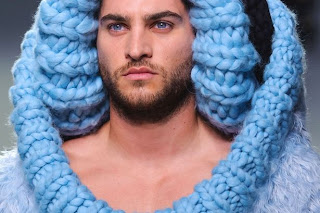
 How often do you get invited to a costume party and think, oh no, I have nothing to wear but my dull, drab, everyday clothes (and I really don't want to use that lame line about having come as myself)? Here's the perfect solution. ("I came as a zebra!")
 Neither this outfit nor mode of makeup seem to have caught on in my hometown yet. But I'm sure it's only a matter of time. (If you do like this look, bear in mind that to pull it off you must wear it with a certain piratical swagger, and not show the slightest trace of sheepishness.)
 How to dress up as your favorite character from a children's book.
 These Thom Browne outfits will bring you back to your Narnia days. (Hello Mr. Tumnus!) It does seem that some of these designers ought to worry less about staying in touch with their inner child and more about developing an outer grownup.
 Had the St. Valentine's Day Massacre taken place on an extra hot day, Al Capone's men could have sashayed into that garage in this shirtless Canali outfit.

A group of local dads are getting together for a few beers before they head over to watch their sons' high school football game. How much would you have to be paid before you wore this Versace outfit for the occasion? (And how much would your son pay you not to?)
 What would the proper occasion be to wear this sheer-lacy-pouchy-undergarment-with-gold-belt-and-formal-tuxedo-jacket-with-pushed-up-sleeves Versace number? Is it more appropriate for a formal, or informal occasion? My suggestion: be bold, try it at both.
 The latest from Acne menswear. Yes, there actually is a clothing company with that name. Which brings up the inevitable question: which would you rather wear, this hat -- or zits all over your face?
 It is often said that a group of young black men hanging out on the street can appear threatening. These three seemed to have discovered a sartorial (and tonsorial) solution to that dilemma.
 Imagine wearing this outfit to a meeting of the local chapter of the Bloods. How do you think your colleagues would react? With restraint and good manners? Or might they manage to somehow overcome their reticence about implying that this is not precisely the image they want to convey?
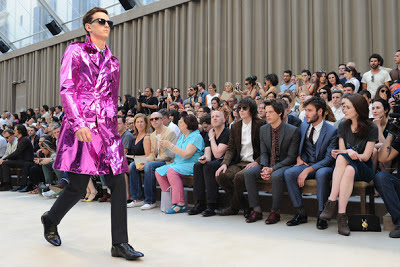 From Burberry, an updated trench coat for the spy who wants only to remain incognito.

 Had that E! show been called The Boys Next Door rather than The Girls Next Door, this is how Hef and his companions might have dressed.
 For those who predict the end of civilization, the perfect post-Apocalyptic camouflage outfit.
 For Salvador Dali fans who like to dress in drag and are in mourning.
At first, some of these styles might look a little bit ridiculous. But with just a little imagination, it's easy to see when and where they could be useful -- or not.


This Salvatore Ferragamo sheer v-neck Day-Glo aqua sweater with prison jumpsuit orange pants is the perfect ensemble for a flower shop, hair salon, or even an internet startup. (It may be a tad less appropriate if you work at a bank, law office, engineering firm, or oil company.)


Sunday, June 16, 2013
"Michelangelo Hid Anatomy Lesson in the Sistine Chapel: Human Brainstem is Depicted in the Image of God"
In May of 2010, medical illustrator Ian Suk and neurosurgeon Rafael Tamargo came out with an astonishing revelation in Neurosurgery: that the painting of God creating Adam on the ceiling of the Sistine Chapel --

-- in fact contains a detailed, anatomically correct representation of the human brain:

Michelangelo frequently dug up corpses from local cemeteries and dissected them, starting at age 17, so had an intimate familiarity with the human body.
There are two schools of thought about Michelangelo's message here. One is that he was celebrating God's greatest gift to Adam, the human brain. The other interpretation is that he was saying that God is merely a creation of the human brain, not the other way around.
Most people seem to have assumed that Michelangelo, often described as a deeply religious man, was sending the former message: that God had endowed Adam with a special brain because He favored humans.
I lean toward the latter interpretation. If Michelangelo had felt that God's greatest gift to Adam was a human brain, why would he not have said so more straightforwardly, rather than putting it in "code," so to speak. Plus, it is God, not Adam, who is contained within the brain, suggesting that it is He, and not he, who is a figment of the imagination.
Michelangelo lived from 1475 to 1564. The Vatican had been established in Rome in 1377, the Spanish Inquisition had its heyday in the late 1400's, and Italy had its own version starting in 1542. In Michelangelo's time, the church had far more power than it does today, and a public declaration of atheism would not have been wise for an ambitious artist.
Michelangelo, as a homosexual, undoubtedly felt himself outside the mainstream, which probably predisposed him towards a different way of viewing many things. (A grandnephew, who published Michelangelo's sonnets in 1623, felt obliged to change the gender of the pronouns in the homoerotic poetry.)
And desecrating the bodies of the dead would certainly not seem to be the act of an instinctively pious man.
Michelangelo must have been confident that people of his time would not recognize the shape for what it was, and that his message -- whatever that was -- would be discovered after his lifetime. And if anybody did happen to recognize the shape, he had plausible deniability: he could just say any perceived resemblance was unintended.
Of course, there is a third interpretation: that Michelangelo had not intended any message, and that the brain shape was merely a lark, a flight of fancy. But this seems unlikely in an era when religion so saturated public life and thinking.
Whatever Michelangelo's intent, it's awe-inspiring that the huge brain -- in effect, the artist's brain -- sat there for half a millennium, gazed at by millions but not truly seen until 2010.
(Would Michelangelo have been surprised at how long it took?)
I find myself shivering in an almost religious rapture at the thought of his overwhelming genius.
Thursday, June 13, 2013
Portrait, Part II
I realized soon after putting up yesterday's post that Bill Clinton's repertoire of poses was far broader than I had given him credit for. So, for your edification and enlightenment, here are a few more:

"I admit it, I may be a little naughty -- but I'm certainly not bad."

"Look what a nice guy I am -- I'm so affectionate I even let my cat climb on my shoulders." [This pose reminds me of nothing so much as those Death Row inmates who pose with pets in order to seem "nice."]

"I wouldn't be using both fingers to point if I didn't really, really mean this very serious point. And the fact that I'm making it, by the way, shows what a very serious person I am."

"Even though I'm God's gift to this country, I still retain my humility -- isn't that amazing?"

"I love being the center of attention, especially with a bunch of fawning sycophants like yourselves."

"I think I evoke JFK, don't you? Look, we have the same haircut."

"Hey, you, what was your name again? Monica? Monica honey, come over here a sec, I got a favor to ask."

"Okay, so we happen to be on stage. Believe me, we're every bit this affectionate in private, too."

"I'm humbled to be in the presence of greatness.....my own, that is. Nelson should feel similarly honored."
Clinton is far more stage actor than movie actor: he is like a ham who is always emoting for the cheap seats. He looks good from a distance; up close, it's a bit much.
It's always the people who seem most sincere, especially those who can summon up such 'sincerity" at a moment's notice, for any occasion, who are the least so.
Wednesday, June 12, 2013
Portrait of a phony
Yesterday I stumbled across a photographic essay called "Bill and Hillary through the years." I can't seem to locate the article today, but I was struck by how phony Bill Clinton looked in all of the shots. He always seemed to be posing, putting on whatever expression he thought most appropriate for the situation. But he always seemed to give himself away by overdoing it.
No matter how slick you are, if you're a sociopath who lives in a goldfish bowl, as Clinton did for eight years in the White House, you can't hide your sociopathy. The sociopaths themselves, of course, always think they're fooling us, but their overconfidence often does them in. Clinton has in fact fooled a lot of people, but he hasn't fooled as many as he thinks he has. For those of us schooled in the ways of sociopaths, he is a textbook case.
Here is a Youtube video of Clinton at the funeral of Ron Brown, his Commerce Secretary: Clinton is laughing and joking, but as soon as he sees the camera pointing at him, he looks down and wipes a nonexistent tear from his eye.
This is the same Bill Clinton who said, during an economic downturn, "I feel your pain." Translation: "I am an empathetic and sympathetic human being." The only problem is, no one who actually feels empathy and sympathy would ever feel the need to point that out.
Take a look at some of these pictures. If you look closely, you'll see each of his poses is almost too good to be true, i.e., he captures the expression he's trying to achieve almost perfectly, which "real" people almost never do.
Here's Bill's humble yet patriotic look:

Here are two photos of Bill shedding his famous crocodile tears (which involve no actual production of water):
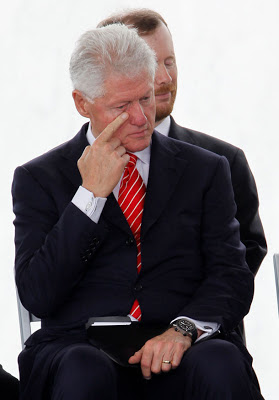

Here's his "You can count on me to fight for you" look:

Here's his "Together, we're gonna win this thing" look:

Here's his "It's just so great to be here with all you wonderful folks -- and look who's here!" look:

Here's his justifiably angry, "I did not have sex with that woman" look:

Here's his "After all these years, I'm still just head over heels for Hillary" look:

Here is what is undoubtedly one of Clinton's favorite photographs of himself, from a rare lean phase. Note the faroff look in his eyes, as if he is contemplating weighty matters, combined with the determined set of his jaw, and the judicious stroking of his chin. What a statesman!

Please bear in mind, this is not just a lesson in Bill Clinton-ism; it is a lesson in sociopathy. Sociopaths often betray their own essentially dishonest natures by overdoing things, demonstrating the falseness of their emotions.
Now, if you didn't take a look at the Youtube video linked above, please do so; it's extremely illuminating.
(Here's my more detailed explanation of Bill Clinton's sociopathy.)
No matter how slick you are, if you're a sociopath who lives in a goldfish bowl, as Clinton did for eight years in the White House, you can't hide your sociopathy. The sociopaths themselves, of course, always think they're fooling us, but their overconfidence often does them in. Clinton has in fact fooled a lot of people, but he hasn't fooled as many as he thinks he has. For those of us schooled in the ways of sociopaths, he is a textbook case.
Here is a Youtube video of Clinton at the funeral of Ron Brown, his Commerce Secretary: Clinton is laughing and joking, but as soon as he sees the camera pointing at him, he looks down and wipes a nonexistent tear from his eye.
This is the same Bill Clinton who said, during an economic downturn, "I feel your pain." Translation: "I am an empathetic and sympathetic human being." The only problem is, no one who actually feels empathy and sympathy would ever feel the need to point that out.
Take a look at some of these pictures. If you look closely, you'll see each of his poses is almost too good to be true, i.e., he captures the expression he's trying to achieve almost perfectly, which "real" people almost never do.
Here's Bill's humble yet patriotic look:

Here are two photos of Bill shedding his famous crocodile tears (which involve no actual production of water):


Here's his "You can count on me to fight for you" look:

Here's his "Together, we're gonna win this thing" look:

Here's his "It's just so great to be here with all you wonderful folks -- and look who's here!" look:

Here's his justifiably angry, "I did not have sex with that woman" look:

Here's his "After all these years, I'm still just head over heels for Hillary" look:

Here is what is undoubtedly one of Clinton's favorite photographs of himself, from a rare lean phase. Note the faroff look in his eyes, as if he is contemplating weighty matters, combined with the determined set of his jaw, and the judicious stroking of his chin. What a statesman!

Please bear in mind, this is not just a lesson in Bill Clinton-ism; it is a lesson in sociopathy. Sociopaths often betray their own essentially dishonest natures by overdoing things, demonstrating the falseness of their emotions.
Now, if you didn't take a look at the Youtube video linked above, please do so; it's extremely illuminating.
(Here's my more detailed explanation of Bill Clinton's sociopathy.)
Monday, June 10, 2013
Sophisticates vs. unsophisticates
Every now and then it occurs to me, that the associations sparked by certain words determine the listener's level of sophistication:
When you hear the name Hannibal, do you first think of the Carthaginian general who crossed the Alps with his elephants, or of Mr. Lecter?
When you hear "SEC," do you expect to hear about the Securities and Exchange Commission, or the Southeastern Conference -- home to the Crimson Tide and the 'Dawgs?
Do the letters WWF evoke the World Wildlife Fund, or the World Wrestling Federation?
Does "superman" bring to mind Friedrich Nietzsche, or Clark Kent?
When you hear "The Talented Mr. Ripley," do you think of the book by Patricia Highsmith, or the movie starring Matt Damon?
Does the word "movement" make you think of the symphonic, or the bowel, kind?
After the words "the rise and fall of," do you expect to hear "The Roman Empire" or "her heaving breasts"?
Do the words "the theater" make you think of David Mamet, or the local movie chain?
Beyond words, there are other associations which give us away:
When you see a bottle of wine, do you wonder about the vintage and variety of grape, or do you think, time to get shit-faced!
When you see a man with a muscular, well-defined body, do you think what an idiot he must be to waste all that time at the gym, or, wow, that guy is jacked!
When you see someone driving a Ferrari, are you dismayed at his vulgarity, or envious of his hot shit car?
Personally, I count myself squarely in the unsophisticated category. On every single one of the examples above (with the possible exception of the SEC), I would have the lower brow reaction.
It's not that I'm really lowbrow: I don't like comic books, and have never been a professional wrestling fan. I'm just middlebrow, and there doesn't seem to be anything I can do about it.
I know that I should have some appreciation for opera, the ballet, fine art, antiquities, and the theater. And honestly, I would.....but they're just so boring.
To me, museums are places I would only go to see specimens of fearsome animals, not Art. Shakespeare was just someone I was forced to read in high school, not a joy to read.
I prefer Kurt Vonnegut, Frederick Forsyth, and Ken Kesey. The middlebrow pantheon.
I know the Russian writers are supposed to be great, but I'm just not interested. Or, at least, am no longer willing to make the effort to wade through those interminable chunks of pavement. (War and Peace was recently recommended to me, but I think I'll just wait for the movie.)
The only good thing I can say about myself is that I'm not pretentious. (Well, at least not about this stuff.) To me, there's nothing more sickening than people who affect an affection for something they think they're supposed to like, not because they actually enjoy it, but because they think it reflects well on them.
You can always tell because they advertise their love. They fall all over themselves letting you know how sophisticated they are. (The converse is also true: if anyone is ever sheepish about a hobby, at least you know he has a real passion for it.)
With the phony sophisticates, it's always their pride that gives them away.
Then again, looking over this post, it sure seems like I'm pretty proud of my lack of sophistication.
(Which is worse? I honestly don't know.)
Tuesday, June 4, 2013
FEMEN now protesting themselves
Those doughty women of FEMEN have been at it again, this time protesting Heidi Klum's live TV show, Germany's Next Top Model.
Two topless protesters crashed the proceedings. One had "Heidi's Horror Picture Show" written across her torso.

Two topless protesters crashed the proceedings. One had "Heidi's Horror Picture Show" written across her torso.

The next day, the group released the following statement on Facebook to explain their actions. Read it carefully:
FEMEN disrupted the live broadcast of Germany's most popular casting-show Germany's Next Top Model. The program format is pimp-show where world-famous supermodel Heidi Klum plays the role of "mom" and forms a bevy of underage girls to fashion-fools. The unauthorized appearance of FEMEN sekstremists at the epicenter of the show broadcasted live made the organizers and participants in the state of torpor. FEMEN sekstremists managed to make their accusations in the face of fashion-fascist ideologist of the show Heidi Klum in front of 15000th stadium and the millions of TV viewers audience. FEMEN regards the fashion industry as an element of pimp business and has consistently opposed the commercialization of the female body. Every year the fashion business millstones grind hundreds of thousands of girls, promoting the brilliance and richness of modeling career, forcing women to false ideals, provoking a real disease. Fooled by fashion propoganda, failed by fashion models, women regularly join the ranks of sex workers, and psychiatric patients. Stop the fashion business! Stop Prostitution! The true mission of a woman is a revolution!


FEMEN disrupted the live broadcast of Germany's most popular casting-show Germany's Next Top Model. The program format is pimp-show where world-famous supermodel Heidi Klum plays the role of "mom" and forms a bevy of underage girls to fashion-fools. The unauthorized appearance of FEMEN sekstremists at the epicenter of the show broadcasted live made the organizers and participants in the state of torpor. FEMEN sekstremists managed to make their accusations in the face of fashion-fascist ideologist of the show Heidi Klum in front of 15000th stadium and the millions of TV viewers audience. FEMEN regards the fashion industry as an element of pimp business and has consistently opposed the commercialization of the female body. Every year the fashion business millstones grind hundreds of thousands of girls, promoting the brilliance and richness of modeling career, forcing women to false ideals, provoking a real disease. Fooled by fashion propoganda, failed by fashion models, women regularly join the ranks of sex workers, and psychiatric patients. Stop the fashion business! Stop Prostitution! The true mission of a woman is a revolution!
"Forms a bevy of underage girls to fashion-fools"?
"The unauthorized appearance of FEMEN sekstremists....made the organizers and participants in the state of torpor"?
This show took place in 15,000 stadiums? (It's much bigger than I thought!)
Failed models automatically become prostitutes?
If you ever want an immediate clue as to the worthiness of a group's cause, take a close look at their missives. Too often they'll betray their level of intelligence with misspellings, inappropriately used words, incorrect grammar, and garbled syntax. The Facebook message above almost reads like one of those Google translations of a foreign language: you just have to guess at the original meaning from the jumble of seemingly disconnected words.
Perhaps I'm being unfair; perhaps the writer of the above manifesto only spoke English as her second, or third language. Even so, she seems guilty of confused thinking.
But while confused thinking may be symptomatic of FEMEN's intelligence level, their hypocrisy is symptomatic of the group's character.
It turns out, as pointed out after this blog's last FEMEN post (by Pete and "W O D"), that FEMEN themselves hold auditions for the role of topless protester. Women who want the job have to be photographed topless in order to be hired (at a salary of $1000 a month) as a protester.
By holding such tryouts, aren't the group doing the exact same thing that they are protesting German's Next Top Model for? In fact, aren't they taking it a step further by insisting that their models pose topless?
On top of which, FEMEN obviously chooses its protesters on the basis of beauty, every bit as much as Heidi Klum's TV show does. If you don't believe that, then you must believe that these FEMEN protesters look like a typical cross section of feminists:


(I'll use any excuse to put pictures of half-naked women in my blog.)
Seriously, FEMEN's behavior is every bit as hypocritical as that of Norman Lear's (described in the post below).
Subscribe to:
Posts (Atom)

 Posts

